

By Brian Low, National Manager – Instructor Certification Program (brian.low@skipatrol.ca)
The patient assessment – it’s critical!
As a patroller in the Canadian Ski Patrol, the patient assessment (PA) is your primary diagnostic tool. Our success in treating a patient is dependent on an effective and efficient PA. The PA is logical and progressive.
Has it changed?
Over the years, minor modifications and improvements have been introduced based on evidenced-based research, practice, and approval of the CSP Medical Advisory Committee. As well, instructional style has evolved over time. The steps to complete your PA have not changed in 2025.
Every time we complete a patient assessment, the circumstances are different. We are required to adapt to the situation, and this requires understanding and critical thinking. The outcome remains the same.
What’s different?
Instruction has changed to ensure understanding of what we are trying to achieve at each stage – what is our desired outcome. The patient assessment is comprised of four distinct stages with specific expected outcomes:
- Scene Survey and Communication,
- Primary Assessment,
- Transportation Decision and Communication,
- Secondary Assessment.
What does that mean to me?
Patient assessment evaluation is included in each member’s annual CSP Skills Record. We each need to demonstrate and verbalize the PA. The evaluation has always included content questions at the end of the PA. These are now replaced by some basic questions that explore your understanding. Based on your choice, questions may be asked before, during, or after your demonstration. You answer the questions briefly in your own words to demonstrate your understanding. This is not memory work.
Take a look!
To help you prepare to demonstrate your patient assessment this year, here are the questions that are included in the 2025 evaluation form. No tricks – just good preparation on your part to be successful.
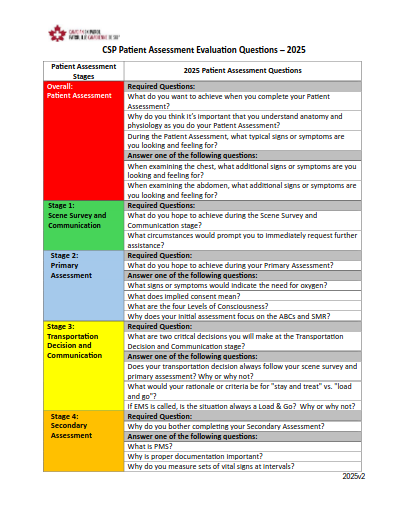 The patient assessment instructional form, and the patient assessment evaluation form may be found in the Student Resources course in the Learning Management System (LMS).
This post is also available in: