By Matt Middleton, Frontenac Zone (matthew.middleton@skipatrol.ca)
On July 26, 2025, I had the opportunity for the second time to help run the Canadian Association of Wilderness Medicine (CAWM) Race.
Hosted at MTB Kingston (Ontario), this year’s four teams had very creative names: Prepare to See Domination, MacGyvers, Pulse Patrol, and Kingston ReanimatORs. Each team consisted of four racers, ranging from first-year medical students to fully qualified physicians.
The race format progressed into increasingly challenging stations that the team must complete before advancing to the next station. The overall structure of the race was as follows:
- Teams are required to start a fire with flint and two cotton balls (safely performed in a disposable baking pan).
- Once completed, the team is given a set of coordinates to locate its first aid kit. (Odyssey Medical partnered with CAWM and provided fully stocked first aid kits along with foldable litters).
- After finding the first aid kit, the team races back to the start line to receive the course map.
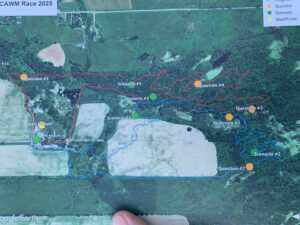
- The team then leaves the start line to complete the 11-km course (broken into two circuits), while answering questions and completing four scenario stations along the way.
The team with the most combined accumulated points for time to finish the course, plus correct answers for the questions found on the course, plus points from the four scenarios is declared the winner.
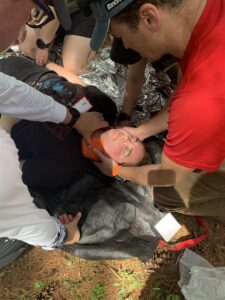
This year’s scenarios involved severe burns from an exploding camping stove, a chainsaw wound leading to a fall from a tree, a hypoglycemic hiker, and an over-the-bars mountain bike crash. My assigned role was the station leader for the mountain bike crash scenario. Our unfortunate patient, Kait, had gone head-first over the handlebars. The following information was given to the teams as they arrived at the station:
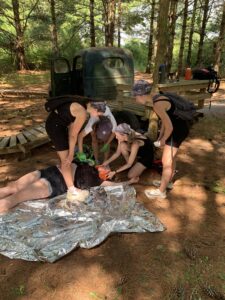
The teams soon discovered that not only did Kait have a natural ability for moulage (applying mock injuries), but also was an ideal patient when it came to them assessing her injuries. For her visible injuries, she had some very impressive makeup: a large bruise that radiated two inches from her navel and a dark bruise on her upper left cheek. We could not have asked for a better patient when it came to her acting ability. She was found unconscious in the prone position, only slightly responded to pain on the AVPU scale when her C-Spine was palpated, and changed up her respiratory rate as the scenario progressed.
Each station had a marking rubric that allocated points based on the team’s ability to assess the injury (similar to the CSP primary assessment), provide treatment with the available supplies, and make a transportation decision on how to extract the patient. It was great to see the different approaches to the scenarios; some came from a hospital/clinical perspective, while others were an in-the-wilderness approach. I observed that one racer seemed to have a natural leader/mentor role with his teammates. Talking to him after the race, I discovered he was a past ski patroller at Mont Tremblant and was very familiar with scenario training!
Like any field day with the CSP, the success of the day is made possible with the support of volunteers. The CAWM race was no different; each team provided a volunteer, and along with the support of approximately 10 others, made the day successful. I was personally grateful for volunteer Miak and his BBQ skills as he presented me a perfectly cooked hot dog and drink when I reached the finish line, both hungry and tired!
I have twice had the opportunity to take part in this race, and twice it has not disappointed. With the zone’s field day a “short” four months away, I look forward to bringing some of the ideas learned to keep building our skills as patrollers.
Find out more about the Canadian Association of Wilderness Medicine at cawm.ca/ or on Instagram @canadianwildmed.
All photos provided by Matt Middleton
This post is also available in: