
By A.P. Crawford (ap.crawford@skipatrol.ca)
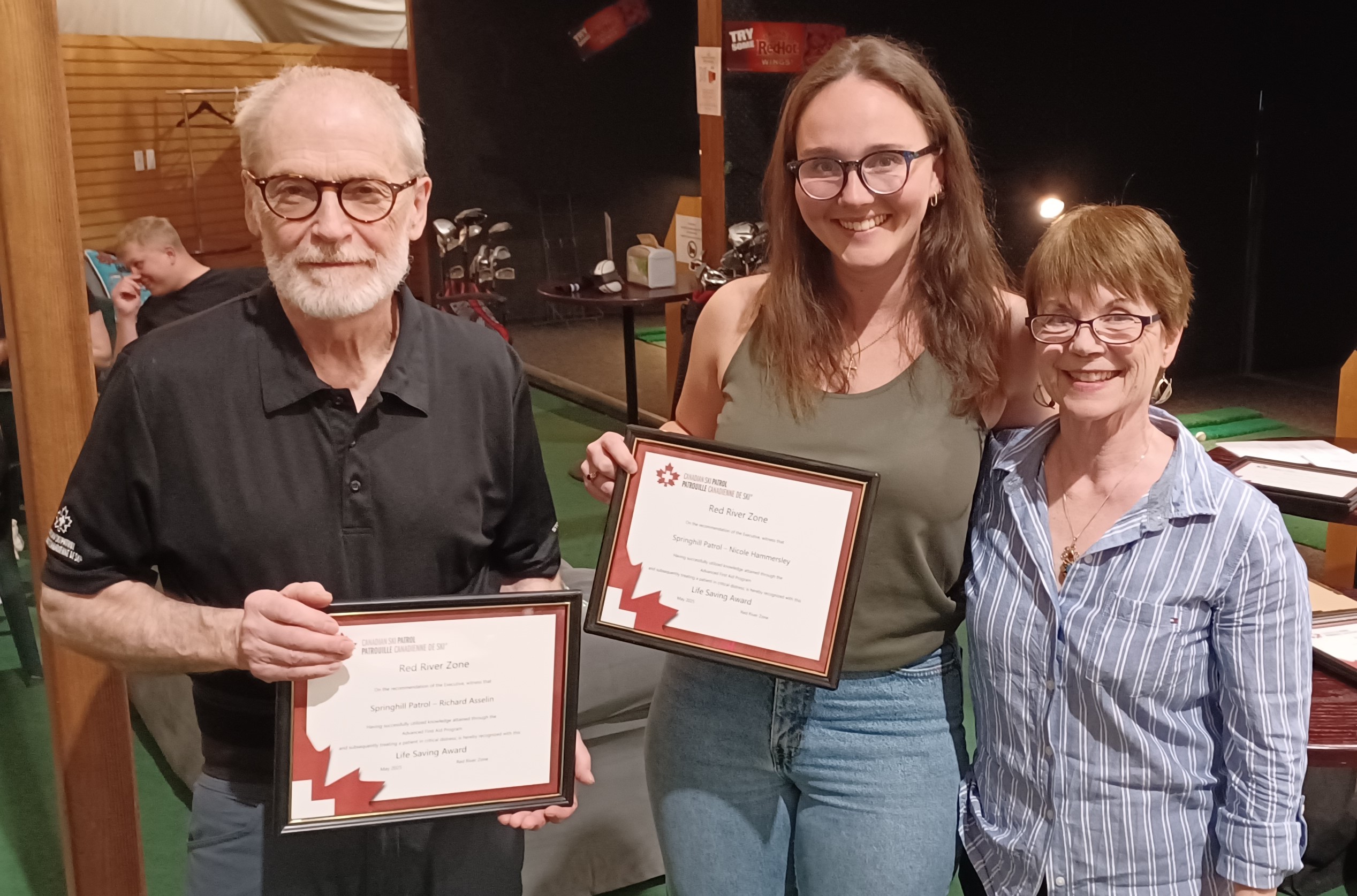
Richard Asselin, George Kryschuk, Nicole Hammersley and Debbie Dixon; Red River Zone, Manitoba Division
On December 27, 2025 at 2:30 p.m. the patrol at Spring Hill Winter Park just outside of Winnipeg, Manitoba, was called to the day lodge to attend to a person lying on the floor. The man was against a wall in the busy hallway between the lunch area and customer service, and adjacent to the rental area.
Richard Asselin was the first to arrive and observed that the man appeared to be unaware of the foot traffic and noise, but Richard was able to obtain the man’s consent as he was conscious and alert. He said he’d fallen on the hill but had not hurt himself, had heartburn and started to feel dizzy so decided to come inside. Richard quickly determined that the man had chest pain, describing it as feeling like pressure radiating over his entire chest area which he’d never experienced before. He also shared that he’d had a beer a couple of hours prior and a small amount of Gatorade, but no food.
George Kryschuk responded to Richard’s request for assistance and began to clear the immediate area. Richard determined that the patient’s breathing was fast and shallow, and his radial pulse was faint and rapid. A decision was made to offer low-dose ASA (81 mg) and to activate EMS.
George retrieved the ASA and brought blankets and kidney basins from the patrol building. The man was assisted to take the ASA and when Richard spoke to EMS dispatch, he was instructed to administer four low-dose pills with small sips of Gatorade.
The patient vomited several times and the ASA pills were clearly visible. While waiting for EMS Richard radioed the patrol for additional assistance and requested a gurney to transport the patient across to the patrol building. By this point, Nicole Hammersley had arrived and the team got the patient into the patrol building. Debbie Dixon was ready with supplies and documentation.
The team noted that the patient’s symptoms were progressing, and his answers to questions had become short and clipped. He often grabbed at or rubbed his chest; his skin was cool, clammy and sweaty; he continued to vomit.
During the assessment questions the patient gave the information that he had a history of diabetes and was on medication which he had taken that morning. He also shared that he’d consumed recreational drugs including marijuana and amphetamines in the past couple of days and that he was feeling very anxious.
The patrol team worked together to set up oxygen saturation monitoring with a pulse oximeter, monitored blood pressure with a cuff, and administered oxygen through nasal cannula. They also reassured the patient, talking with him to keep him conscious.
The EMS team arrived and began its assessment. An EKG showed a type of heart attack that indicates a complete blockage of one of the major arteries and changes how electrical currents move through the heart’s lower chambers. EMS contacted the St. Boniface Hospital Cardiac Services Unit in Winnipeg, and the patient was transported at 3 p.m., just 30 minutes after the patrol was first summoned.
In September of 2025 the CSP was proud to award the team of Richard Asselin, George Kryschuk, Nicole Hammersley and Debbie Dixon with the John D. Harper Lifesaving Award for their actions. Sadly, George Kryschuk had passed away so his award was presented posthumously (his CSP obituary can be found here.)
This post is also available in: